

Twist Rate, RPM, and Their Effects on Terminal Performance With Monolithic Bullets
What Spin Actually Does — and What It Doesn’t
By Aaron Peterson — Hawkeye Ammosmithing
Data-driven ballistics, tested & proven
Introduction: Where the RPM Myth Comes From
In modern hunting and long-range shooting circles, twist rate and rotational speed are often credited as major drivers of terminal performance — and for some reason, particularly when discussing monolithic, petal-shedding bullet designs.
This narrative is commonly tied to bullets from manufacturers such as Apex Outdoors, Hammer Bullets, Cutting Edge Bullets, Lehigh Defense, and similar designs where controlled petal shedding is a primary component of terminal behavior.
Statements like:
“Fast twist makes them kill better.”
“The more RPM, the better they kill.”
“Spinning them faster keeps the shank stable through the animal.”
are frequently repeated.
Most originate from real-world success paired with an incomplete understanding of the mechanical forces involved during impact.
The goal of this article is not to argue against fast twist barrels or monolithic bullets — both have legitimate applications and can perform exceptionally well when properly matched.
Instead, the purpose is to clearly separate:
• what rotational speed genuinely affects in regards to terminal performance
• what it does not
• and why confusing the two has fueled persistent ballistic myths
The Primary Role of Twist Rate: Stability — Nothing More
Twist rate exists for one reason: gyroscopic stability in flight.
A bullet must spin fast enough to remain dynamically stable and maintain nose-forward orientation throughout its trajectory. This is commonly represented by the stability factor (SG).
For most conventional cup-and-core bullets:
SG ≈ 1.4–1.6 is typically sufficient.
For many monolithic bullets — which are longer grain-for-grain due to lower material density — higher stability margins are required:
SG ≈ 2.0+
However, once sufficient stability is achieved:
 additional RPM does not meaningfully increase accuracy additional RPM does not increase energy additional RPM does not inherently improve terminal performance
Accuracy is driven primarily by:
• barrel quality
• chamber geometry
• load tuning and consistency
• velocity ES/SD
• shooter fundamentals
Not by spinning the bullet faster than stability demands.
Where RPM Can Matter — Early and in a Narrow Window
With petal-shedding monolithic bullets — such as those produced by Apex Outdoors, Hammer, Cutting Edge, and Lehigh Defense — rotational speed can play a limited but real role during the initial phase of impact.
Higher RPM can assist with:
• quicker petal initiation
• more complete, symmetric, and consistent petal shedding
• improved reliability near the lower end of the intended impact velocity range
This occurs through centrifugal force acting on mechanically weakened petal sections once resistance is encountered.
However, this influence is:
• secondary
• limited in magnitude
• confined to the earliest moments of impact
RPM does not create terminal performance — it merely helps certain designs execute their mechanical function more reliably.
Once petals have shed, rotational speed’s terminal contribution is effectively finished.
Reliability Limits in Petal-Shedding Monolithic Bullets
While petal-shedding monolithic bullets can perform very well when functioning as intended, real-world use shows that certain designs are far more susceptible to specific failure modes than others, with the better-engineered bullets demonstrating significantly greater consistency across seasons and platforms.
New examples surface each year where recovered projectiles show:
• collapsed cavities where hydraulic opening failed to occur
• partial or uneven petal initiation and separation
• imbalanced shanks that deviated or tumbled during penetration
These outcomes are most commonly observed following:
• glancing contact with bone
• initial impact through dense tissue
• non-square entry angles
• high stress deformation of soft copper alloys
Importantly, these behaviors are not isolated to heavy-for-caliber bullets.
They have been observed across a range of weights and velocities, reinforcing that the primary drivers are material behavior and cavity geometry, not bullet mass alone.
Common Failure Modes
One failure mode occurs when the bullet material is too soft relative to cavity geometry and impact velocity.
Instead of the cavity opening and transmitting outward force, the nose can deform inward — effectively nosing over and collapsing the cavity.
When this happens:
• the cavity closes off
• hydraulic forces are reduced or eliminated
• petal initiation may fail entirely
The bullet then behaves as a long, narrow penetrator rather than performing as designed.
Another documented failure mode involves asymmetrical petal shedding.
If petals do not forms and/or release evenly:
• mass balance is disrupted
• CG and CoP relationships shift
• yaw or tumbling can occur
This instability can cause directional changes during penetration.
In real-world terms, this may result in:
• vital organs being missed
• unpredictable wound paths
• insufficient penetration for quick, clean kills
Even when tissue damage appears significant, variability increases the likelihood of unfavorable outcomes.
Tips, Stems, and Initiation Systems
Why “Tipped” Doesn’t Automatically Mean Better Terminal Performance
A common assumption is that tipped monolithic bullets inherently reduce cavity collapse and improve reliability. In many cases, a well-designed tip system does help, but simply having a tip does not guarantee improved terminal behavior.
Some tipped designs exist primarily for aerodynamics: higher BC, better retained velocity, and reduced wind drift. Those benefits improve external ballistics but do not necessarily improve mechanical and terminal performance in tissue.
For a tip to meaningfully enhance terminal reliability, it must function as part of an initiation system.
Properly integrated tip systems can:
• support the cavity mouth and resist inward collapse
• transmit force into the cavity to pressurize it
• promote outward petal formation
• improve symmetry and consistency of shedding
However, effectiveness depends on details such as:
• tip material properties
• stem length and geometry
• mechanical coupling to the cavity
• beveled or chamfered cavity interfaces
• retention timing during impact (snapping off upon impact)
If these elements are poorly executed, the tip may do little more than improve aerodynamics.
Hydraulic Media in the Cavity — Useful but Difficult to Apply Consistently
Some shooters have experimented with oils, wax-like fillers, or similar media placed inside bullet cavities to prevent collapse and promote hydraulic opening.
While the principle works — resisting inward folding and transmitting outward pressure — consistency is difficult to maintain.
Challenges include:
• variable fill amount from bullet to bullet
• loss of media during handling or flight
• imbalance in mass distribution
• inconsistent initiation behavior
Inconsistent cavity media can also affect external ballistics and impact orientation, increasing the risk of nose collapse or asymmetrical shedding.
What works in isolated cases can become unreliable across real-world conditions.
After Petal Shedding: What Actually Drives Penetration Behavior
Once petals have shed and the bullet transitions into the remaining shank, new forces dominate.
Penetration depth and wound behavior are driven primarily by:
• impact velocity (hydraulic force)
• frontal area of the shank
• mass and momentum
• drag stabilization geometry (shoulder stabilization)
• mass balance
Rotational speed contributes little at this stage.
Spinning faster does not:
 increase penetration guarantee straight-line travel reliably increase tissue destruction
Tumbling Explained: CG, CoP, and Instability
Tumbling or significant yaw occurs when the center of pressure (CoP) moves too close to the center of gravity (CG) — or when the CoP shifts behind the CG.
When that relationship becomes unstable:
• yaw increases
• deviation occurs
• tumbling may follow
This behavior is governed by geometry and mass distribution, not RPM.
Using Cayuga Bullets as a Physics Example — and Why Tumbling Is Unreliable
Some bullet designs intentionally attempt to induce instability through CG/CoP manipulation.
An example is the Cayuga monolithic bullets produced by Patriot Valley Arms (PVA), which incorporate a shallow cavity meant to allow limited nose upset and shift stability relationships.
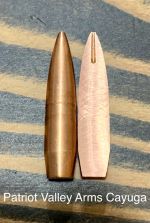
While this demonstrates how tumbling can be mechanically induced, it should be mentioned why tumbling is actually an unreliable terminal mechanism.
Tumbling is highly sensitive to:
• impact velocity
• tissue resistance
• entry angle
• degree of deformation
• small balance variations
This leads to extreme variability in penetration and wound paths and thus unreliable results overall.
Controlled, repeatable terminal behavior consistently outperforms chaotic mechanisms.
Why Faster Twist Often Gets the Credit
Shooters frequently attribute improved terminal performance to faster twist rates because:
✔ marginal stability issues are resolved
✔ petal shedding becomes more consistent
✔ long monos stop flying on the edge of stability
✔ accuracy improves as SG reaches ideal ranges
The improvement is real — but the cause is commonly misunderstood.
The twist rate corrected a stability issue, not a terminal mechanics issue.
The Bigger Picture: Design and Velocity Drive Terminal Performance
Across all bullet types, the dominant drivers remain:
- Bullet construction
- Impact velocity window
- Mass retention behavior
- Frontal area evolution
- Post-impact stability governed by geometry
Twist rate ensures the bullet arrives properly oriented.
After that, design and velocity dominate.
Final Thoughts
Fast twist barrels are valuable tools — especially for long, low-density bullets — but they are not terminal performance multipliers.
RPM can assist early petal initiation in some designs.
It does not replace sound bullet engineering.
Terminal performance is a system — not a shortcut.
By Aaron Peterson — Founder, Hawkeye Ammosmithing
“Data-driven ballistics, tested & proven.”
“Data-driven ballistics, tested & proven.”
 Instagram
 YouTube
 Facebook