

Ballistic Coefficient, Time of Flight, Wind Drift, and Lethality
By Aaron Peterson — Founder, Hawkeye Ammosmithing
“Data-driven ballistics, tested & proven.”
“Data-driven ballistics, tested & proven.”
Why So Many Smart People Get This Wrong — and What Actually Matters
Few topics in long-range shooting generate more confident misunderstanding than ballistic coefficient (BC), wind drift, and time of flight. You’ll routinely hear statements like:
- “There’s no such thing as a bullet that bucks the wind.”
- “Wind drift is just time of flight.”
- “BC predicts drop, not wind.”
- “BC doesn’t really work in the real world.”
- “Different bullets end up needing the same wind hold anyway.”
What makes these statements persistent isn’t that they’re completely wrong — it’s that they’re partially right, and then pushed too far.
This article exists to do one thing:
replace slogans and anecdotes with mechanisms.
No marketing.
No mysticism.
No appeals to authority.
Just physics, uncertainty, and how the system actually behaves.
Why This Conversation Starts in the First Place: Lethality, Not BC
Amongst the hunting community, most of these debates don’t start with BC. They start with lethality.
We can calculate kinetic energy easily. But energy is only potential. Whether that energy actually goes to work depends entirely on:
- bullet design and construction
- impact velocity
- resistance encountered in tissue
- shot placement and anatomy
Without efficient conversion of kinetic energy into hydraulic force, energy numbers are meaningless. Plenty of bullets impact with impressive energy and then fail to:
- disrupt tissue effectively
- cause rapid blood loss
- induce sufficient CNS shock or pressure spikes
This is why terminal ballistics cannot be reduced to energy alone.
Bullet designers don’t design around energy.
They design around velocity windows.
Which brings BC into the discussion — not as a lethality variable, but as an enabler.
Where BC Actually Fits
BC does not make a bullet lethal.
BC does not replace construction.
BC does not guarantee terminal performance.
But BC matters in two critical ways:
1) It increases hit probability
Higher BC bullets are less sensitive to wind uncertainty. Less drift sensitivity means fewer misses caused by imperfect wind calls — especially at distance.
2) It preserves impact velocity
Higher BC bullets retain velocity better downrange, keeping them within their designed performance window longer.
That’s a big reason why I focus on impact velocity, not energy, when setting shot limits. BC helps maintain that velocity — but it does not replace proper design.
BC is not the mechanism.
It is the margin.
What Ballistic Coefficient Actually Is
Ballistic coefficient is a drag efficiency metric — a shorthand describing how efficiently a bullet moves through air relative to a reference model.
Higher BC means:
- lower drag
- slower velocity decay
- higher retained velocity downrange
BC is not:
- wind resistance
- a lateral-force rating
- a complete aerodynamic model
But drag governs everything that happens in flight.
Stability Sets the BC You Actually Get
Ballistic Coefficient isn’t just about bullet shape — it assumes the bullet is properly stabilized. If a projectile isn’t spinning fast enough to maintain clean, nose-forward flight, drag increases dramatically.
That means:
• Lower real-world BC than advertised
• Faster velocity decay
• More wind drift
In practice:
- Cup-and-core bullets typically need SG ≈ 1.5+
- Monolithic solids often need SG ≈ 2.0+
Below those ranges, BC degrades quickly.
Once proper stability is achieved, however, increasing SG further does not meaningfully increase BC.
The bullet is already flying clean, so additional spin mostly adds margin, not performance.
Stability unlocks BC. It doesn’t keep boosting it. Think of BC like a sports car’s top speed — you don’t reach it unless the road conditions allow it. Stability is the road.
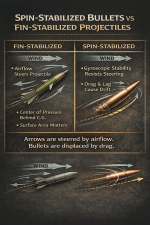
Spin-Stabilized Bullets vs Fin-Stabilized Projectiles
A major source of confusion in wind drift discussions comes from unintentionally applying intuition from fin-stabilized objects — such as arrows, rockets, and missiles — to spin-stabilized rifle bullets.
While all of these travel through air, they remain stable for fundamentally different reasons, and that difference directly changes how wind forces act on them.
Fin-stabilized projectiles remain nose-forward because their center of pressure sits behind their center of gravity. Airflow naturally steers them back into alignment, much like a weather vane. In this system, aerodynamic side forces actively influence the projectile’s direction of travel, and surface area plays a large role in how much it is deflected.
This is why ideas like “more side area catches more wind” feel intuitive — and are reasonably accurate — for arrows and rockets.
Bullets, however, are stabilized almost entirely by gyroscopic spin.
Rifle bullets are rotating hundreds of thousands of revolutions per minute. That rotational stability resists overturning moments created by aerodynamic forces and prevents the projectile from weather-vaning into the wind.
In fact, for spin-stabilized bullets, stability is achieved with the center of pressure (CoP) positioned forward of the center of gravity (CG), with sufficient separation between the two. Aerodynamic forces act at the CoP, while the bullet’s rapid spin provides gyroscopic stiffness that keeps the nose from being steered by the airflow.
Instead of being turned by the wind, a bullet behaves more like a spinning top being gently displaced sideways.
The crosswind does not steer the bullet. It applies a lateral force that results in gradual deflection governed by aerodynamic drag and the amount of time the bullet lags behind the moving air mass.
This is why, for spin-stabilized bullets, drag behavior, captured in ballistic coefficient, governs velocity decay, time of flight, and wind drift.
Concepts such as side surface area and “catching the wind” are useful mental models for fin-stabilized flight, but they do not accurately describe how bullets respond to crosswind.
Much of the confusion around wind drift comes from applying fin-stabilized intuition to spin-stabilized bullets, even though bullets resist aerodynamic steering and are governed primarily by drag.
Gravity and Drop: The Easy Part
Gravity is constant.
It acts equally on all bullets at 32.174 ft/s^2
Bullets drop because they’re in the air for a certain amount of time. More time in flight means more drop.
BC does not defy gravity.
BC influences how long gravity has to act by influencing velocity retention.
This part is simple — and most shooters understand it.
Where things break down is when this same simplification is applied to wind drift.
Wind Drift Is Not “Wind Pushing the Bullet”
This is the root misconception behind most bad conclusions.
Wind does not shove a bullet sideways like a leaf.
Wind drift results from aerodynamic side force acting on a spinning projectile, integrated over the entire flight. That force depends on:
- velocity
- drag behavior
- bullet shape and stability
- exposure time
Time matters — but time alone is not the driver.
If wind drift were simply wind speed × time of flight:
- BC wouldn’t matter
- drag models wouldn’t matter
- velocity decay wouldn’t matter
Yet all of those things clearly do matter — both in solvers and on target.
The Missing Concept: Lag Time
A simplified engineering approximation for wind deflection is:
Wd = 17.6 × Ws × Tlag
Where:
- Wd = wind deflection (inches)
- Ws = wind speed (mph, full value)
- Tlag = lag time (seconds)
- 17.6 = conversion factor to get the solution to be in inches
Lag time is defined as:
Tlag = ToF − ToF(vacuum)
And vacuum time of flight is simply:
ToF(vacuum) = distance ÷ muzzle velocity
Here’s the key insight:
Lag time exists only because of drag.
No drag → no lag → no wind deflection in this model.
BC controls drag.
Drag controls velocity decay.
Velocity decay creates lag time.
That’s why BC matters for wind drift — not because it “bucks” wind, but because it reduces wind sensitivity.
Why Phrases like, “It’s Just Time of Flight” Is Incomplete
Two bullets can:
- start at the same muzzle velocity
- arrive at similar or even slightly different times
- and still show very different wind drift
That alone disproves the idea that drift is purely time-based.
Time correlates with drift — but drag is the reason time matters.
A Real-World Example: Speed vs BC
Extreme muzzle velocity can partially compensate for low BC — early.
At shorter distances:
- speed dominates
- drag hasn’t fully asserted itself
- differences look small
But drag compounds.
Velocity decay accelerates.
Lag time grows.
There is always a crossover distance where:
- velocity advantage collapses
- BC dominates
- wind drift diverges sharply
Speed works — until it doesn’t.
For example:
Lets take a 124gr 30cal bullet with a G7 BC of .169 with a muzzle velocity of 4220fps. At 500 yards with a 10mph full value constant wind, it will experience 14.8" of drift, be at 2739fps, and have 2066ft-lbs of kinetic energy potential. At 1000 yards it will have drifted 80.8", be at 1556fps, and have 667ft-lbs of kinetic energy potential.
Now, lets take a different 30cal bullet, at 215gr, with a G7 BC of .356 with a muzzle velocity of 3000fps. At 500 yards with a 10mph full value constant wind, it will experience 11.2" of drift, be at 2362fps, and have 2663ft-lbs of kinetic energy potential. At 1000 yards it will have drifted 51.1", be at 1806fps still, and still have 1557ft-lbs of kinetic energy potential.
To a certain point, all is well, especially if that certain point isn't over your intended range anyway. After a certain point, the low BC will decay the velocity so rapidly that you'll limit your range due to dipping below the lower impact velocity limit of the bullet, and you'll still experience more wind drift at a given distance.
Lets break it down further and use our formulas
So first of all, Lag time (Tlag) is defined as the difference between actual ToF and the ToF in a vacuum.
So Tlag in the formula posted earlier is not simply ToF. To get Tlag, the equation is:
Tlag = ToF - ToFvac
To calculate ToFvac, divide the distance, in feet, by the MV of the bullet.
For the 124gr bullet:
ToFvac = 3000/4220 = 0.7109 (rounded)
Tlag = 1.17 - 0.7109 = 0.4591
So now to get the wind deflection:
Wd = 17.6 * 10 * 0.4591 = 80.80"
For the 215gr bullet:
ToFvac = 3000/3000 = 1.0000
Tlag = 1.29 - 1.0000 = 0.2900
Wind deflection:
Wd = 17.6 * 10 * .2900 = 51.04"
So, due to things like the higher BC of the 215gr bullet, the lag time is ultimately lower, and thus the amount of calculated drift is lower even though the ToF is lower with the 124gr bullet. There are many other factors and variables that affect actual POI, however. We'll go over those later.
From Physics to the Target: Why Wind Drift Often Looks Wrong in the Real World
Once you understand that aerodynamic drag is what governs velocity decay — and that this decay is what drives both time of flight and wind deflection — the physics of wind drift become fairly straightforward.
Where things begin to get confusing isn’t in the equations, it’s on the target.
In real shooting, we’re never observing wind drift in isolation. What we actually see is a combination of:
- aerodynamic deflection from the wind
- rifle and load dispersion
- shooter input
- and environmental variability
All of those stack together into what we call a “group.”
And when those layers get mixed, they can easily create the illusion that BC either matters far more than it should — or not at all.
Wind Drift vs Group Dispersion — Two Very Different Things
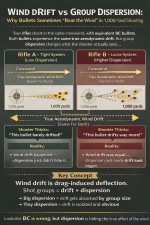
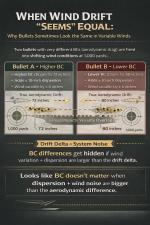
Wind drift is a systematic aerodynamic deflection driven by drag behavior. Group size, however, is that drift plus everything else layered on top of it. When dispersion is small relative to drift, wind effects appear clean and obvious. When dispersion is large relative to drift, wind effects become distorted or hidden entirely. This is where many of the real-world “BC doesn’t predict wind” observations originate.
When Drift Is Revealed
In a highly consistent shooting system, such as low SD, good tune, minimal vertical and horizontal spread, dispersion is small. In that case, wind drift shows up as a shifted but round group. Shooters often describe this as a bullet that “holds wind well.” In reality, the bullet is drifting exactly as physics predicts — it simply isn’t being masked by system noise.
When Drift Is Masked
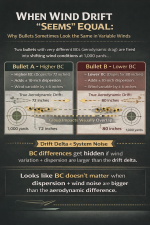
In a less consistent system, dispersion and wind variability can be larger than the aerodynamic difference between bullets.
When that happens:
- higher BC bullets and lower BC bullets may appear to drift the same
- or one system may look like it drifts dramatically more
Not because the physics changed, but because the signal is buried inside noise. This is especially common when comparing real-world groups instead of measured deflection.
The Two Common Illusions
Illusion #1 – Drift looks larger than it is
Loose systems (rifle, optics, shooter, ammo, etc.) exaggerate wind effects by stacking dispersion on top of aerodynamic drift.
Illusion #2 – Drift looks the same across bullets
When dispersion exceeds drift differences, BC effects become visually indistinguishable on target.
(See infographic below for a visual breakdown of both cases.)
The Reality
BC-driven wind deflection never stopped working. What changed was the clarity of the measurement. When precision is high, physics becomes obvious. When precision is low, physics gets hidden.
Key takeaway
Many real-world examples that appear to disprove BC’s role in wind drift are actually measuring rifle dispersion — not aerodynamic deflection.
Why Industry Voices Sometimes Reach the Wrong Conclusion
Several experienced voices in the industry have made statements along the lines of:
- BC predicts drop well, but not wind
- there’s no real formula for drift
- different bullets often need the same wind hold
- benchrest shooters succeed with lower BC bullets
Each observation contains truth.
The conclusions drawn from them do not.
Wind uncertainty ≠ BC irrelevance
Wind drift is harder to predict because wind is harder to know — not because BC is meaningless.
Similar wind holds ≠ equal drift
If the difference is smaller than system uncertainty (wind gradients, hold resolution, target size), it disappears in noise.
Benchrest ≠ field shooting
Benchrest minimizes wind uncertainty. BC advantage shows up most when wind uncertainty exists — which benchrest deliberately reduces.
Anecdotes lack resolution
Hitting the same target with the same hold does not isolate drift differences.
This is not physics failing.
It’s uncertainty masking.
When Small Errors Masquerade as “BC Problems”
Another major contributor to BC skepticism is input error.
Small setup errors compound rapidly at distance.
For example:
- A ½″ sight height error can produce ~1″ error at 500 yards and ~2″ at 1000
- A ½″ zero error at 100 yards can produce ~2″ at 500 and ~5″ at 1000
Stack them together and you’re several inches off — before wind is even considered.
High muzzle velocity makes this worse by magnifying sensitivity.
When shooters then “fix” the mismatch by adjusting BC, they create a second layer of error. The solver matches one distance and falls apart elsewhere.
BC gets blamed — incorrectly.
Why BC Gets Mischaracterized as a “Drop Variable”
Drop is predictable.
Wind is not.
So drop predictions feel more accurate.
That does not mean BC is less relevant to wind drift. It means wind uncertainty dominates error, not that the physics changed.
BC influences wind drift at least as much as drop at long range — often more — because wind uncertainty is where misses live.
How BC, Accuracy, and Lethality Actually Interact
A truly effective long-range hunting bullet must:
- be accurate enough for precise placement
- have sufficient BC to reduce wind sensitivity
- retain velocity to stay within its performance window
- convert velocity into hydraulic force efficiently
BC helps with getting hits and arriving with usable velocity.
Construction determines what happens after impact.
You cannot evaluate one without the other.
The Correct Diagnostic Order
Before questioning BC or solvers:
- Verify zero
- Measure sight height accurately
- Confirm true muzzle velocity
- Validate atmospherics
Only then does it make sense to evaluate drag modeling.
Skipping these steps and blaming BC is how myths propagate.
Additional Considerations in Real-World Ballistics
While aerodynamic drag and ballistic coefficient govern the dominant behavior of bullet flight — including velocity decay, time of flight, and wind drift — real-world shooting environments introduce additional factors that can influence observed results.
These do not invalidate BC-based models, but they can add secondary effects that become more noticeable under certain conditions.
Meplat Variation and Shot-to-Shot BC Consistency
Another contributor to perceived BC “inaccuracy” is meplat variation within a bullet lot. Small differences in tip shape and/or opening diameter alter the local drag profile enough to produce shot-to-shot BC variation. This does not invalidate BC as a predictive tool — it simply highlights the effect of aerodynamic inconsistency. Processes such as pointing or trimming can reduce this variation and tighten groups by improving uniformity, even if they slightly reduce average BC by ultimately increasing drag. What shooters often observe as improved wind performance after trimming and/or pointing is frequently improved consistency rather than a reduction in true wind drift.
Transonic Effects
As bullets approach the transonic region, airflow behavior becomes non-linear and drag increases rapidly. During this transition, effective ballistic coefficient can change significantly, causing drop and wind drift to deviate from simple supersonic predictions.
This is one reason long-range impacts near the transonic boundary may not perfectly match solver outputs, even when BC values are accurate at higher velocities.
Ballistic Coefficient Is Not Constant
Ballistic coefficient is not a fixed physical property of a bullet. It represents an averaged description of drag behavior across a range of velocities.
As a projectile slows, airflow characteristics change and effective BC changes with it — particularly as the bullet transitions through different flow regimes.
For modern long-range boat-tail bullets, drag behavior is far more accurately represented using a G7 model or a custom drag model (CDM) than a traditional G1 curve. G7 more closely matches the shape and flow characteristics of streamlined boat-tail projectiles, while CDMs capture the bullet’s true drag behavior across its entire velocity range.
The older G1 model was developed around flat-base, blunt-nose projectiles and is better suited to bullets of that general shape. When applied to modern low-drag bullets, G1 often requires large corrections and can mask how BC actually changes as velocity decays.
Three-Dimensional Wind Fields
Wind is rarely uniform across a bullet’s entire flight path. Shear layers, vertical components, terrain effects, and localized gusts can introduce both horizontal and small vertical deflection in addition to primary crosswind drift.
These effects become more prominent in complex terrain and long flight times.
Precision vs Aerodynamic Effects at Short Range
At short distances where time of flight is minimal, intrinsic rifle and load precision dominate group size.
As distance increases and wind deflection grows, aerodynamic performance — governed by drag behavior and BC — increasingly becomes the controlling factor.
Key takeaway from this section
These effects add nuance to real-world shooting but do not replace the fundamental role of aerodynamic drag in governing velocity decay and wind drift.
The Real Takeaways from This Article
- BC does not “buck” the wind — it reduces wind sensitivity
- Wind drift is aerodynamic side force integrated over flight
- Lag time, not total time of flight, is the driver in simplified models
- Speed helps early; drag dominates late
- Wind uncertainty often masks BC advantage
- Input error frequently masquerades as physics failure
- BC is an enabler, not a lethality mechanism
Final Thoughts
External ballistics is not intuitive.
It is systemic.
When slogans replace mechanisms, even experienced voices can reinforce myths instead of correcting them.
BC isn’t magic.
Velocity isn’t everything.
Wind isn’t pushing bullets sideways.
But the physics is real, measurable, and predictable — and once you understand how drag, lag time, uncertainty, and construction interact, the contradictions disappear.
That understanding leads to:
- better bullet choices
- better wind decisions
- better limits on your shots
And far fewer bad arguments online.
By Aaron Peterson — Founder, Hawkeye Ammosmithing
“Data-driven ballistics, tested & proven.”
“Data-driven ballistics, tested & proven.”
Foundational Physics & Acknowledgment:
Much of the modern understanding of external ballistics — particularly regarding drag modeling, ballistic coefficients, time of flight, drop, and wind deflection — is built on the extensive research and experimental work of engineers and ballistic scientists such as Bryan Litz, and Applied Ballistics. A large portion of the physical framework discussed throughout this article is directly informed by that body of work.
The goal here is not to reinvent those principles or replace that work already published, but to translate them into practical, intuitive terms, address common misconceptions that still come out of it, and connect external ballistics more directly to real-world shooting and terminal performance — which is one of the main emphasis’ of this site.
____________________________________________________________
FAQ: Ballistic Coefficient, Wind Drift, Time of Flight, and Real-World Performance
 Is there really no such thing as a bullet that “bucks the wind”?
The phrase is imprecise, but the performance difference it tries to describe is real. Bullets don’t overpower wind, but some bullets are far less sensitive to it. Higher BC bullets retain velocity better and accumulate less aerodynamic side force over flight, resulting in less wind drift. No magic, just physics. Is wind drift just wind speed multiplied by time of flight?
No. That’s an oversimplification. Wind drift is aerodynamic side force integrated over the bullet’s flight. Time matters, but drag and velocity decay determine how that time matters. If drift were only about total time of flight, BC wouldn’t matter, but it clearly does. Why do people say “time of flight is what matters for wind drift”?
Because time of flight correlates with both drop and drift, especially at shorter distances. The mistake is stopping there. In simplified models, wind deflection depends on lag time, not total time of flight. What is lag time, and why is it important?
Lag time is the difference between a bullet’s actual time of flight and how long it would take to travel the same distance in a vacuum:Tlag = ToF − ToF(vacuum)
Lag time exists only because of drag. Wind deflection models key off lag time because it represents how much the bullet deviates from ideal, drag-free motion. BC directly influences lag time by controlling drag.
Does BC really matter for wind drift, or is it mostly a “drop variable”?
This is one of the most common misconceptions. BC influences wind drift at least as much as—and often more than—vertical drop at long range. Gravity is constant and predictable. Wind is not. BC reduces wind sensitivity by controlling drag and velocity decay, which is why higher-BC bullets show dramatically less drift at distance. Does BC affect drop at all?
Yes, but indirectly. Gravity acts equally on all bullets. BC affects drop by influencing velocity retention, which affects time of flight. Less time in the air means less drop. BC does not defy gravity; it limits how long gravity has to act. Can a faster, lower-BC bullet ever drift less?
Yes, at shorter distances. Extreme muzzle velocity can partially compensate for low BC early in flight. However, drag accelerates velocity decay, and there is always a crossover distance where the higher-BC bullet pulls away as distance increases. Why do different bullets sometimes seem to require the same wind hold in the real world?
Because uncertainty often masks the difference. Wind gradients, imperfect wind calls, shooter hold resolution, and target acceptance zones can easily overwhelm small differences in predicted drift. Similar wind holds do not mean bullets drift the same, it means the system can’t resolve the difference yet. Does this mean ballistic solvers are inaccurate?
No. Ballistic solvers model the physics correctly, but they depend on inputs that are imperfect, especially wind. When predicted drift doesn’t match observed impacts, the issue is usually wind uncertainty or input error, not BC or the solver. Why do drop predictions seem more reliable than wind predictions?
Because gravity is constant and wind is variable. Drop predictions feel more accurate because vertical motion is easier to model and verify. That does not mean BC is less relevant to wind drift, it means wind uncertainty dominates horizontal error. Why do some experienced shooters or industry voices say BC doesn’t predict wind drift well?
Because they’re observing real uncertainty, then misattributing it. Wind drift is harder to predict because wind is harder to know, not because BC is irrelevant. BC still governs drag, velocity decay, lag time, and wind sensitivity. Uncertainty masks the advantage; it doesn’t erase it. Why do some benchrest shooters use lower-BC bullets successfully?
Because benchrest minimizes wind uncertainty. Benchrest shooting involves known conditions, flags across the range, and waiting on conditions. BC advantage matters most when wind uncertainty exists-- benchrest deliberately reduces it. Group performance under controlled conditions does not translate directly to first-round hit probability in the field. How do small setup errors affect BC and drift evaluation?
Dramatically.Small errors in:
- zero
- sight height
- muzzle velocity
Should I true BC to match my drop or drift?
This is a big one. The answer is yes, but only after verifying:- Zero
- Sight height
- True muzzle velocity
- Atmospherics
Is muzzle velocity overrated?
No, but it’s often misunderstood. Speed helps early in flight and reduces drop and drift inside a bullet’s efficient range. The mistake is assuming speed continues to dominate as distance increases. Drag and lag time always catch up.BC and Hunting-Specific Questions
Why does BC even matter for hunters? Animals aren’t steel plates at 1,000 yards.
Because wind uncertainty and impact-velocity margin matter more to hunters than most shooters realize.BC does not make a bullet lethal. Construction and placement do. But BC:
- reduces wind sensitivity, increasing first-round hit probability
- preserves impact velocity, keeping the bullet within its designed performance window
I’ve killed a lot of animals with low-BC bullets. Doesn’t that prove BC isn’t important for hunting?
No, it proves those bullets work, not that BC is irrelevant.Low-BC bullets can be outstanding hunting bullets, especially:
- at shorter distances
- in lighter wind
- when impact velocity is high
- when the shooter knows their limits
Does that mean hunters should always choose the highest-BC bullet available?
The short answer is no.Hunters should choose bullets that:
- shoot accurately in their rifle
- perform reliably within known impact-velocity windows
- perform reliably within their particular distances they'll be hunting
- match realistic distances and conditions
How does BC relate to lethality for hunting?
Indirectly.BC improves hit probability by reducing wind sensitivity and preserves impact velocity by reducing drag. Terminal performance depends on bullet construction and impact velocity, not BC alone. BC enables lethality by keeping the bullet within its designed velocity window longer.
Why focus on impact velocity instead of energy?
Because energy is only potential. Bullet designers design around velocity windows, not energy numbers. Expansion, fragmentation, and hydraulic force depend on impact velocity. BC helps retain velocity, but construction determines how that velocity is used. If BC matters so much, should I always choose the highest-BC bullet?
Not necessarily.BC is one variable among many. Accuracy, stability, terminal behavior, and realistic conditions matter just as much. BC is a tool, not a religion.
What’s the single biggest mistake people make in these debates?
Confusing uncertainty with irrelevance.Wind uncertainty, setup error, and measurement limits often mask BC’s advantages. That doesn’t mean BC doesn’t matter, it means the system is noisy.
If you had to sum it all up in one sentence?
BC doesn’t “buck” the wind. It reduces wind sensitivity by managing drag and lag time, which is why it matters most at distance.| Distance & Conditions | BC Importance | Why It Matters |
|---|---|---|
| Inside ~300 yd, light wind | Low | Impact velocity and bullet construction dominate terminal performance; wind sensitivity is minimal. |
| 300–500 yd, variable wind | Moderate | Wind uncertainty begins to dominate misses; higher BC reduces wind sensitivity and improves hit probability. |
| 500+ yd, near ethical limit | High | BC preserves impact velocity and significantly reduces wind sensitivity where margin is smallest. |
| Any distance, gusty or unknown wind | High | Higher BC increases forgiveness when wind calls are imperfect or changing. |
Closing Perspective
BC doesn’t replace judgment, discipline, or shot placement. It simply reduces how much perfection the shot requires. For hunters especially, that margin is often the difference between a clean kill and a bad outcome.
 Instagram
 YouTube
 Facebook